
South Carolina Housing Market Report: Mid-2026 Update
As of mid-2026, South Carolina's housing market has settled into more balanced territory. The median home price statewide is sitting in the mid-$300,000s, inventory is up roughly 8% year over year, and mortgage rates are holding in the low 6% range. That combination means more choices and more negotiating room for buyers than the state has seen in several years, while sellers who price their homes correctly are still closing deals in a reasonable timeframe. Whether you are searching for a home in the Charleston Lowcountry or keeping an eye on the broader state market before making a move, here is what the numbers actually mean for you right now.
Home Prices Across South Carolina in 2026
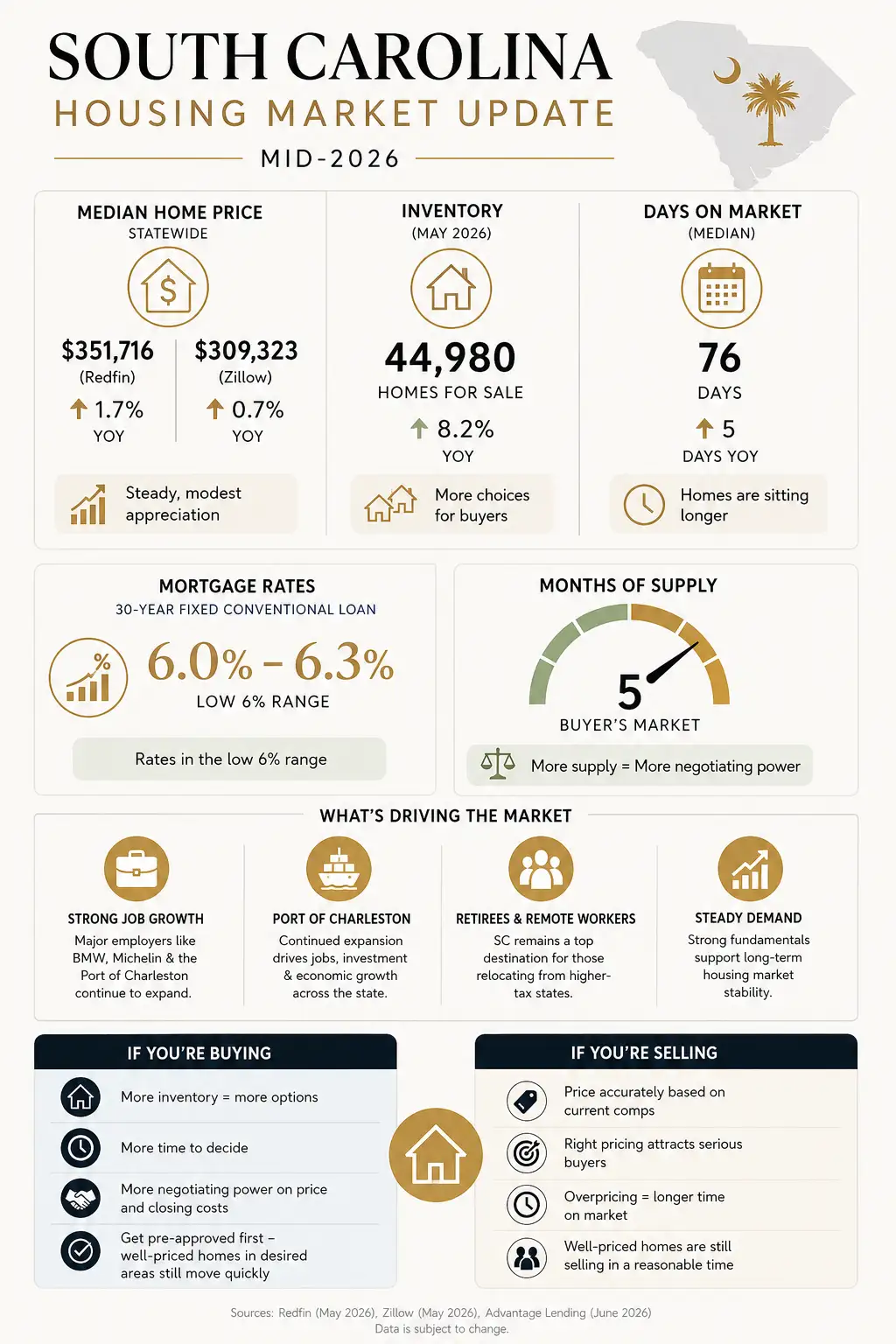
Depending on which source you look at, home values across South Carolina are showing modest, steady growth rather than the sharp swings buyers saw a few years ago. According to Redfin, the median sale price statewide reached $351,716 in May 2026, up 1.7% from the year before. Zillow puts the average home value slightly lower at $309,323, up 0.7% year over year, using its own home value index methodology. The gap between those figures comes down to how each source calculates value, but the trend line agrees: this is a market of slow, sustainable appreciation, not a boom.
Regionally, coastal markets like Charleston continue to command premium pricing compared to inland cities such as Greenville, Spartanburg, and Columbia, which remain some of the more affordable metros in the state.
Inventory and Days on Market
Buyers have noticeably more to choose from this year. Statewide inventory was up 8.2% year over year as of May 2026, with 44,980 homes for sale according to Redfin. Homes are also sitting on the market a bit longer, with a median of 76 days statewide, up 5 days from last year. Months of supply is sitting around 5, a level that generally favors buyers over sellers.
For buyers, this means less pressure to make a rushed decision or waive contingencies just to compete. For sellers, it means pricing accurately matters more than it did during the frenzy years, since overpriced homes are more likely to sit.
Mortgage Rates and Affordability
Mortgage rates in South Carolina are currently hovering in the low 6% range, typically between 6.0% and 6.3% for a standard 30-year fixed conventional loan depending on credit profile, according to Advantage Lending. Combined with rising inventory, this is modestly improving affordability and giving first-time buyers a bit more breathing room than in recent years, though rates remain above pre-pandemic levels.
What's Driving the Market
South Carolina's growth story hasn't slowed down. Major employers like BMW and Michelin, along with the continued expansion of the Port of Charleston, are fueling strong job growth across the state. On top of that, South Carolina consistently ranks as a top destination for retirees and remote workers relocating from higher-tax states in the Northeast and Midwest, which keeps steady demand flowing into both coastal and inland markets.
What This Means If You're Buying or Selling in the Charleston Lowcountry
If you're a buyer, this is one of the more favorable stretches in recent memory to start your search. You have more inventory to look through, more time to make a decision, and more room to negotiate on price or closing costs, especially on homes that have been sitting for a while. Getting pre-approved before you start touring is still the smartest first step, since well-priced homes in strong school zones are still moving quickly.
If you're selling, accurate pricing based on current comparable sales matters more now than it did a couple of years ago. A home priced right for today's market will still attract serious buyers, but overpricing based on last year's numbers is more likely to result in a longer time on market.
I recently worked with a family relocating to the Lowcountry from out of state who assumed they would be competing against a dozen other offers on every home they liked. Once they saw current inventory levels and days on market data for their target neighborhoods, they were able to negotiate a lower price and a seller-paid closing cost credit on their first offer, something that would have been much harder to get even two years ago.
Conclusion
The South Carolina housing market in 2026 is behaving like a market finding its footing, with steady prices, growing inventory, and mortgage rates that, while still elevated compared to pre-pandemic years, are no longer climbing. For a closer look at how these trends are playing out specifically in Summerville, you can read our Summerville real estate market update. If you want a breakdown of what these numbers mean for your specific neighborhood or price range in the Charleston Lowcountry, that is exactly the kind of conversation worth having before you list or make an offer.
Ready to talk through what the current market means for your next move? Book a free consultation with Alicia or call 843-345-5204.
Frequently Asked Questions
Is South Carolina's housing market slowing down in 2026?
It's stabilizing rather than slowing down in a concerning way. Prices are still rising, just at a much more modest pace than in previous years, while inventory and days on market are both increasing. That points to a healthier, more balanced market rather than a downturn.
Is now a good time to buy a home in South Carolina?
For many buyers, yes. Rising inventory and longer days on market mean less competition and more negotiating power than in recent years. The right timing still depends on your personal finances, credit, and how long you plan to stay in the home, so it's worth talking through your specific situation with a local agent and lender.
How does the Charleston Lowcountry market compare to the rest of South Carolina?
Charleston and the surrounding Lowcountry typically command higher prices than inland cities like Greenville or Columbia, largely due to coastal demand and limited land supply. Days on market and inventory trends in the Lowcountry generally track close to the statewide averages, though popular communities in Summerville and Nexton often move faster than the state median.
Categories
Recent Posts