

How to Price Your Home to Sell in Summerville SC
The single most important decision you will make when selling your Summerville home is the price you put on it the day it hits the market. Get it right and you attract serious buyers quickly, generate strong offers, and walk away with the most money possible. Get it wrong — even slightly — and you can watch your home sit, lose momentum, and eventually sell for less than you would have gotten if you had priced it correctly from day one. This guide walks you through exactly how pricing works in Summerville's 2026 market and what you need to know before you list.
What Summerville's 2026 Market Is Telling Sellers
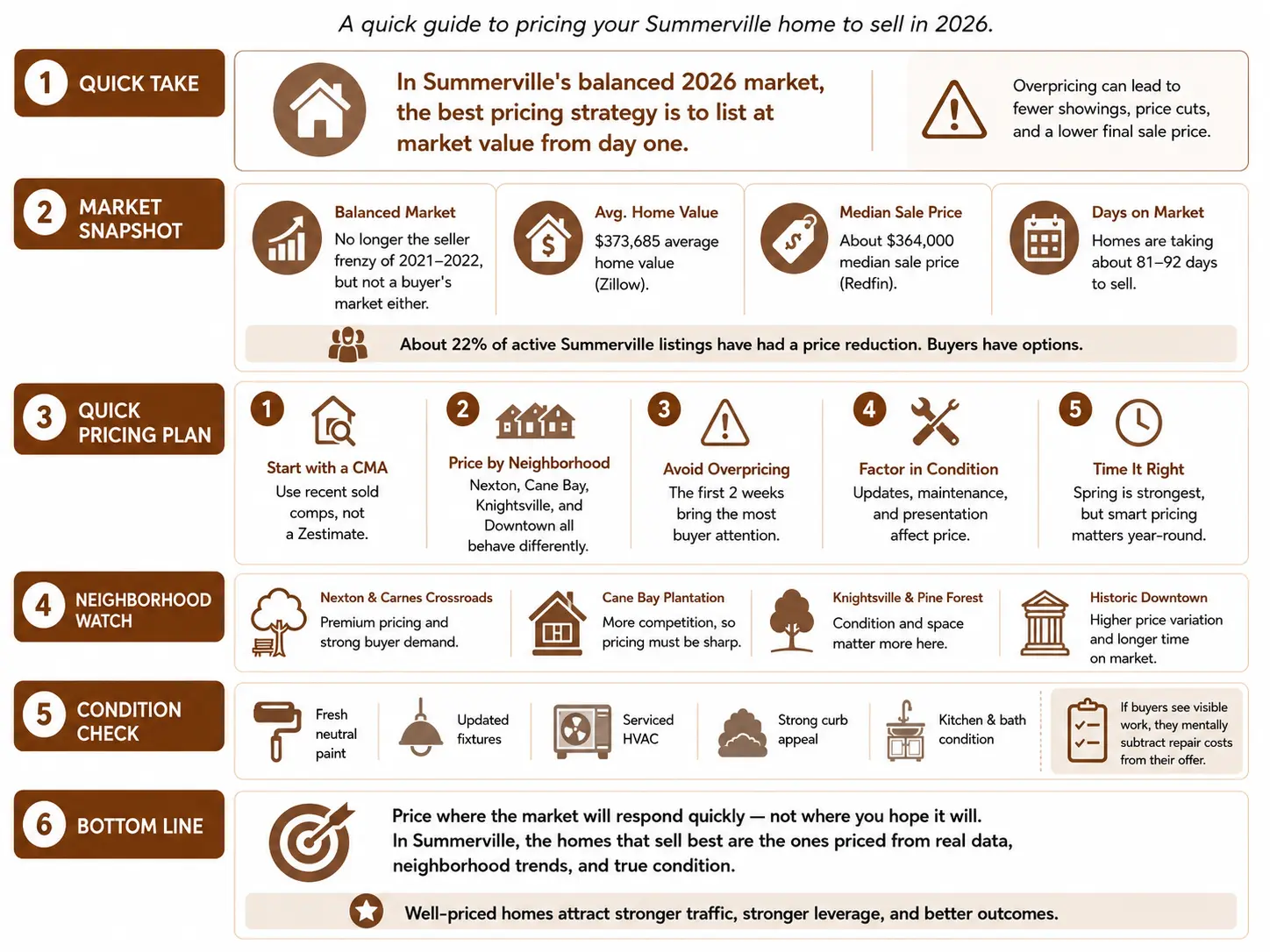
Before you can price your home, you need to understand the market you are selling into. Summerville in 2026 is a balanced market — not the seller's frenzy of 2021 and 2022, and not a buyer's market either. According to Zillow, the average home value in Summerville sits at approximately $373,685, up 1.7% year over year. Redfin puts the median sale price around $364,000, with homes spending roughly 81 to 92 days on market depending on the month.
What those numbers tell you is that buyers have options right now. Inventory has grown compared to 2023 and 2024, and roughly 22% of active Summerville listings saw a price reduction in recent months. Homes are still selling — but only the ones that are priced right from the start. The days of listing 10% above market and watching buyers compete are behind us for now.
This matters because your pricing strategy in 2026 has to account for a more discerning buyer. They are comparing your home to everything else in that price range on their phone before they ever schedule a showing. If your price is off, they skip you — and they may never come back, even after you reduce it.
Step 1: Start with a Comparative Market Analysis, Not an Online Estimate
The most common mistake sellers make is pricing their home based on a Zillow Zestimate or a neighbor's sale from 18 months ago. Both of those are starting points at best — and dangerous anchors at worst.
A Comparative Market Analysis, or CMA, is how serious sellers and their agents actually price homes. It pulls recently sold homes in your area that are genuinely comparable to yours — similar square footage, bedroom and bathroom count, lot size, age, condition, and neighborhood. From those comparables, you establish a fair market value range for your specific property.
In Summerville, a strong CMA will look at sold properties within the past 60 to 90 days, ideally within a one-mile radius. You want sold prices, not list prices. What a neighbor hoped to get is not the same as what a buyer actually paid. The difference between those two numbers tells you everything about where the market really is.
I provide free CMAs for sellers in Summerville and across the Lowcountry. It is one of the most valuable tools I offer, and it costs you nothing to find out what your home is actually worth before you list.
Step 2: Price for the Neighborhood, Not the City
Summerville is not one market — it is a collection of distinct communities, each with its own pricing dynamics. A home in Nexton commands different numbers than a comparable home in Knightsville or Pine Forest. Understanding those differences is critical to pricing accurately.
Here is a rough breakdown of how neighborhoods affect price in the current market:
- Nexton and Carnes Crossroads: Premium pricing driven by amenities, walkability, and strong DD2 school demand. Buyers pay more here and they know it. Correctly priced homes in these communities still move relatively fast.
- Cane Bay Plantation: Large inventory means more competition. Pricing needs to be sharp relative to active listings — not just recent sales — because buyers have real choices within the community itself.
- Knightsville and Pine Forest: Established neighborhoods with loyal buyer pools who value space and mature landscaping. Pricing is more sensitive to condition and updates here than in newer communities.
- Historic Downtown Summerville: A smaller, slower market with high price variance. Days on market run considerably longer here — Redfin shows the Historic District averaging over 200 days. Price expectations need to match that reality.
Your agent should be able to tell you exactly where your neighborhood sits in the current market and how that affects where your price should land.
Step 3: Understand What Overpricing Actually Costs You
This is the part most sellers do not hear clearly enough. Overpricing your home does not just mean it sits longer. It often means you ultimately sell for less than you would have if you had priced it correctly from day one.
Here is why. The first two weeks a home is on the market are its highest-visibility window. That is when buyer interest peaks, when agents are alerting their clients, and when the most showings happen. If your price is too high during that window, buyers skip you. By the time you reduce the price, those buyers have already moved on to other homes — and the ones who do see your reduced price often wonder what is wrong with the property. A price reduction signals weakness, and buyers use it as leverage to negotiate harder.
In Summerville's current market, where about 1 in 5 active listings has already had a price reduction, buyers are watching for this pattern. A home that has sat for 60 days and dropped its price twice is a different psychological proposition than a home that came on correctly priced and drew two offers in the first week.
The goal is not to leave money on the table. The goal is to generate enough buyer traffic early that the market sets your price competitively — which typically happens when you come in at or just below what the data supports.
Step 4: Factor in Condition, Updates, and Buyer Perception
A CMA gives you a range, not a fixed number. Where you land within that range depends heavily on your home's condition and how it compares to the competition.
Buyers in 2026 are pickier about condition than they were in 2021. With more inventory to choose from, they will pass on a home that needs obvious work in favor of one that is move-in ready — unless the price reflects the difference. Before you price, walk your home the way a buyer would and ask yourself honestly: what would this person see that might give them pause?
Updates that move the needle most in Summerville right now:
- Fresh interior paint in neutral tones
- Updated light fixtures and hardware
- Clean, well-maintained HVAC with recent service records
- Landscaping that makes a strong first impression from the street
- Kitchen and bathroom condition relative to comparable homes in the neighborhood
A home that is in excellent condition relative to its comps can push to the top of the range. A home that needs visible work should price toward the middle or lower end — and factor in that buyers will mentally add the cost of those repairs to whatever they offer.
Step 5: Time It Right
Pricing strategy in Summerville is also seasonal. Spring — March through May — is historically the strongest window for sellers, when buyer activity peaks and competition for well-priced homes is highest. Homes listed in spring 2025 were seeing contracts in roughly 18 to 45 days for correctly priced properties, with some going above asking price in the most desirable communities.
Summer stays active, particularly for families trying to close before the school year starts. Fall slows somewhat. Winter is the quietest period, but with the least competition on the market — a strategic opportunity for sellers in a hurry who price aggressively.
If you have flexibility on when you list, aligning your timeline with peak buyer demand gives you the best chance of generating early competition and a strong offer.
What I Tell Every Seller I Work With
I had a client in Summerville last year who was convinced her home was worth $40,000 more than the comps supported. She had put real money into updates and felt the market should recognize that. I understood where she was coming from — but I also knew what the data was saying. We went back and forth, and she ultimately agreed to list at the number the CMA supported. The home went under contract in 11 days with two offers. She walked away confident and on time.
Pricing is not about what your home means to you. It is about what it means to the buyer standing in your living room comparing it to the three other homes they toured that week. My job is to bridge those two perspectives — and to make sure you never leave money on the table by starting too low, but also never lose momentum by starting too high.
If you are thinking about selling your Summerville home in 2026, the conversation starts with a free CMA and an honest look at the current market. You can book a free seller consultation directly on my site, or call me at 843-345-5204. There is no pressure and no obligation — just real information about what your home is worth and what it will take to sell it well.
For more on the selling process, see my guide on how to price your home in a normal market for a broader look at the principles behind smart pricing strategy.
Frequently Asked Questions
How long does it take to sell a home in Summerville, SC right now?
In 2026, correctly priced homes in Summerville are going under contract in roughly 30 to 60 days on average, with well-priced homes in high-demand communities like Nexton moving faster. Overpriced homes are sitting significantly longer — some 80 to 90 days or more — before requiring a price reduction. The best way to protect your timeline is to price accurately from the start.
Should I price my home high to leave room for negotiation?
In most cases, no — not in Summerville's current market. Buyers are comparing your home to everything else online before scheduling a showing. A price that is too high simply removes you from their consideration set. Homes that generate early traffic and multiple showings create natural negotiating leverage without needing to start artificially high. The data consistently shows that correctly priced homes net more than overpriced ones that sit and reduce.
Do I need an appraisal before listing my home?
A pre-listing appraisal is not required, but it can be useful in certain situations — particularly for unique properties that are hard to comp or for sellers who want an objective third-party valuation before they list. For most Summerville homes, a thorough CMA from a local agent who knows the specific neighborhoods provides the pricing intelligence you need. If you are unsure which approach fits your situation, that is a great first question to bring to your consultation.
Categories
Recent Posts